
Keeping Up with Rapidly Changing Technologies
Front-end development evolves at a very fast pace. Therefore, developers must learn new tools constantly to stay relevant. For instance, modern frameworks help you build interactive sites easily. Consequently, continuous learning is the best way to adapt to these quick changes.
- Modern Frameworks: React and Vue allow for building scalable user interfaces.
- Build Tools: Tools like Vite streamline your workflow and improve speed.
Cross-Browser Compatibility
Websites often behave differently across various browsers. Because of this, testing is a vital step for every project. Moreover, using standard CSS reduces unexpected layout issues. As a result, users get a consistent experience regardless of their choice of browser.
- Multiple Browsers: Regular testing ensures that your site functions everywhere.
- Stat: About 45% of users will leave a site if it looks broken on their browser.
Optimizing Website Performance
A fast-loading website is crucial for user satisfaction. Thus, developers should focus on image compression and clean code. Furthermore, caching techniques help reduce repeated server requests. Consequently, your site becomes much more responsive and efficient.
- Image Optimization: Compressing files helps reduce loading times significantly.
- Caching: Implementing cache speeds up page delivery for returning users.

Responsive Design Challenges
Modern users access websites from many different devices. For this reason, responsive design is now a necessity. Additionally, testing on real phones helps find hidden issues. In summary, flexible layouts ensure your content looks great on any screen size.
- Flexible Units: Use percentages and ems to allow layouts to adjust seamlessly.
- Stat: Mobile devices now account for over 58% of total web traffic globally.
Managing State in Complex Applications
Managing data becomes harder as applications grow in size. However, state management libraries provide a structured solution. Specifically, dividing data into small pieces improves performance. Therefore, your app remains stable even with complex user interactions.
- State Libraries: Redux and Vuex help manage application data effectively.
- Data Segmentation: Organizing data reduces unnecessary updates and boosts speed.

Ensuring Accessibility
Accessible interfaces ensure that all users can interact with your site. In other words, you must design for people with disabilities. Moreover, simple practices like readable contrast make a big difference. Consequently, your application becomes more inclusive for everyone.
- Keyboard Navigation: All features should work without using a mouse.
- ARIA Labels: Proper attributes help assistive technologies read your content.
Debugging Complex Code
Identifying issues in large applications can be very time-consuming. Nevertheless, a systematic approach helps you find errors quickly. For example, browser tools are perfect for inspecting code. Thus, isolation of components makes fixing bugs much easier.
- Developer Tools: Use console logs and breakpoints to pinpoint issues.
- Stat: Developers spend nearly 35% of their time debugging existing code.

Integrating APIs Efficiently
Connecting to external APIs brings challenges like latency and reliability. Therefore, implementing proper error handling is vital. Moreover, using modern syntax makes your code more readable. As a result, the application remains stable even if the API fails.
- Async/Await: This approach simplifies code and improves overall readability.
- Error Handling: Planning for failures ensures a better user experience.
Maintaining Code Quality
High-quality code is much easier to scale over time. Consequently, you should follow consistent formatting and linting rules. Additionally, breaking functionality into reusable components improves organization. In short, clean code saves time for you and your team.
- Modular Code: Using components makes your project easier to manage.
- Meaningful Comments: Good documentation helps others understand your logic.
Security Concerns
Front-end security is essential for protecting sensitive user data. Because of this, you must validate all inputs carefully. Furthermore, enforcing HTTPS protects information during transmission. Therefore, following these steps prevents common malicious attacks effectively.
- Input Validation: Checking user input helps stop injection vulnerabilities.
- HTTPS Enforcement: Secure connections ensure that data remains private.

Keeping Users Engaged
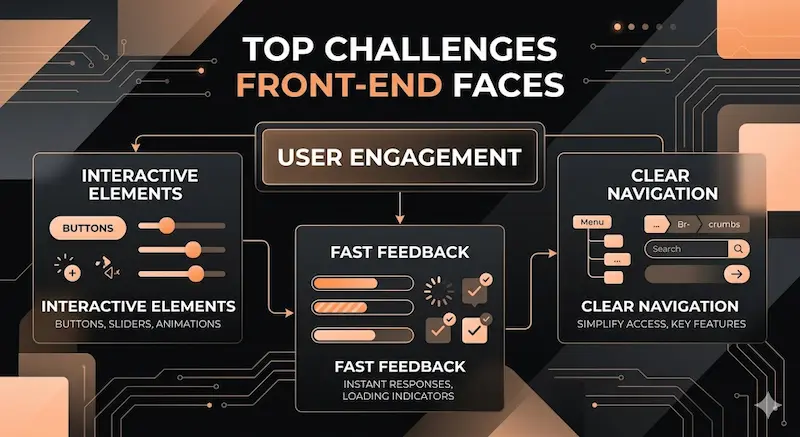
A well-designed interface plays a key role in retaining users. Specifically, interactive elements like animations make the site more engaging. Moreover, clear navigation allows people to find information quickly. Consequently, providing fast feedback improves overall user satisfaction.
- Fast Feedback: Immediate responses to user actions improve usability.
- Stat: Sites with fast interactive elements see a 20% increase in user retention.