

1. The Role of AI in Apps and Websites
Artificial intelligence has become a core part of modern digital experiences. Furthermore, it helps apps and websites understand user needs quickly. Consequently, platforms deliver faster, more accurate, and highly interactive services. Therefore, AI supports different stages, ranging from data analysis to significantly improving the overall user experience.
- Understanding User Behavior: Additionally, AI analyzes user interactions and visits to identify patterns and recurring needs.
- Automating Tasks: Moreover, it handles repetitive processes automatically, thus reducing the time needed to complete common operations.
- Supporting Decisions: Furthermore, AI turns available data into useful insights, which ultimately supports more accurate decisions.
Key AI Applications
2. Integrating Smart Chatbots
Smart chatbots are among the most visible AI applications today. In addition, they provide users with an interactive way to receive answers and assistance instantly. Furthermore, they can be connected directly to platform data to deliver responses that match the user’s context. According to McKinsey, more than 80% of surveyed organizations were already investing in generative AI for customer service, thereby showing its growing role.
- Instant Responses: Consequently, this helps users access information quickly without waiting for direct human assistance.
- Continuous Support: Moreover, systems provide assistance around the clock while efficiently handling multiple requests at once.
- User Guidance: Furthermore, they recommend suitable actions based entirely on the user’s current questions and needs.
Benefits of Smart Assistants

3. Personalized Recommendations and User Experience
AI allows digital platforms to move away from standard experiences. Instead, it creates more personalized interactions by analyzing user preferences, browsing activity, and previous history. McKinsey found that 71% of consumers expect personalized interactions. However, 76% become frustrated when these expectations are not met, highlighting the critical importance of personalization.
- Smart Recommendations: Specifically, platforms show options that directly match the user’s interests and previous behavior.
- Personalized Content: Moreover, content is organized and displayed according to individual user preferences.
- Relevant Offers: Furthermore, systems present specific options that match user needs instead of generic suggestions.
Ways to Personalize Experiences
4. AI and Higher Conversion Rates
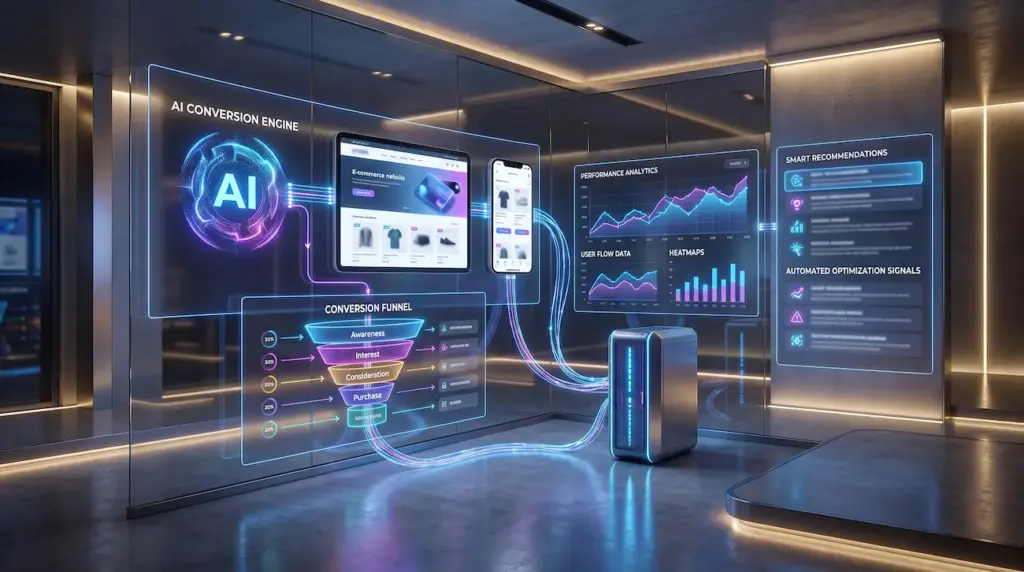
AI can influence much more than just the visual experience. Specifically, it helps improve the entire user journey before a final action is completed. Additionally, it analyzes exit points and recommends relevant content at the right moment. Adobe reported that retail visits from generative AI sources achieved a 31% higher conversion rate than other traffic sources during the 2025 holiday season.
- Journey Analysis: Consequently, this helps identify stages where users stop and improves those parts of the experience.
- Personalized Offers: Moreover, showing relevant options increases the likelihood of completing actions successfully.
- Smart Assistance: Furthermore, guidance is provided whenever user behavior indicates that additional support is useful.
Elements That Support Conversion
5. Generating Interactive Content with AI
AI can generate various types of content within apps and websites, including text, summaries, and automated descriptions. Consequently, this creates a dynamic experience where content changes based on user input rather than remaining identical for everyone. According to the Stanford AI Index 2026, organizational AI adoption reached 88% in 2025, demonstrating how quickly AI is integrated into operations.
- Automated Text: Specifically, AI creates descriptions, responses, and summaries based on available information.
- Interactive Content: Moreover, it produces responses that shift dynamically according to user questions and context.
- Information Summaries: Furthermore, large amounts of content are turned into clear points that are easy to understand.
AI Content Applications
6. Analyzing User Behavior
Apps and websites generate massive amounts of data through searches, clicks, and purchases. Therefore, AI processes this information quickly to identify patterns that are often difficult to discover through traditional analysis. As a result, businesses gain deep insights into their audience.
- Pattern Detection: Specifically, AI identifies repeated behaviors and connects them directly with user needs.
- Predicting Needs: Moreover, it estimates future actions accurately based on previous user interactions.
- Performance Measurement: Furthermore, systems compare results to pinpoint areas requiring continuous improvement.
Areas of Behavioral Analysis

7. AI-Powered Search Experiences
AI transforms traditional search into a smart system that understands the underlying meaning of a query rather than just matching keywords. Adobe reported that U.S. retail website visits from generative AI sources increased by 3,500% between mid-2024 and mid-2025. Consequently, this reflects the growing importance of AI-driven discovery and search systems.
- Understanding Questions: Specifically, systems process the complete meaning of a question instead of isolated keywords.
- More Relevant Results: Moreover, information is ranked according to its exact relevance to the user’s context.
- Conversational Search: Furthermore, users can ask follow-up questions and refine their search naturally.
Improving Search Experiences
8. Security and Privacy in AI Integration
Integrating AI requires careful handling of data, especially when systems process personal information. Therefore, clear rules should determine what data is collected and how it is accessed. The Stanford AI Index 2026 reported that organizations without responsible AI policies decreased from 24% to 11% during 2025, although security challenges remain vital.
- Data Minimization: Specifically, platforms collect only the information necessary for the required function.
- Access Control: Moreover, strict definitions specify which systems and users can access sensitive data.
- Output Review: Furthermore, AI-generated results are checked carefully before using them for critical decisions.
Key Protection Requirements

9. Improving App and Website Performance
AI supports overall performance monitoring by identifying technical problems, analyzing resource usage, and detecting traffic anomalies. Consequently, it predicts potential issues before they negatively impact the user experience. As a result, website stability is maintained continuously.
- Usage Monitoring: Specifically, AI analyzes traffic and resource consumption to identify unusual pressure.
- Problem Prediction: Moreover, systems detect early signals that indicate potential future performance issues.
- Resource Optimization: Furthermore, efficient methods are applied to manage requests, data, and workloads.
Performance Improvement Areas
10. The Future of AI in Apps and Websites
The future of digital platforms is moving rapidly toward AI-centric experiences. Instead of just responding to commands, future systems will understand context and act proactively. The Stanford AI Index 2026 found that generative AI reached 53% global adoption within three years, demonstrating an exceptionally fast adoption curve compared with older technologies.
- Smart Assistants: Specifically, they are moving from simply answering questions to completing multiple tasks.
- Adaptive Experiences: Moreover, content and interfaces will automatically change according to user behavior.
- AI Agents: Furthermore, intelligent agents will become capable of completing connected tasks based on goals.