
Define Flutter App Goals Before Development
A successful app starts with clear goals. Therefore, you must define core functions before choosing tools. Proper planning reduces complexity. Moreover, it helps focus your resources on features that deliver real value.
Key Steps for Defining Requirements:
- Define Core Features: First, identify essential functions. Next, prioritize them to avoid unnecessary features during the initial development stage.
- Understand Users: Additionally, consider user needs and behaviors. Consequently, you can create interfaces that support a practical experience.
- Plan for Growth: Finally, plan for future increases in users and data. Thus, your infrastructure can support expansion without major changes.
Choose the Right Flutter Architecture
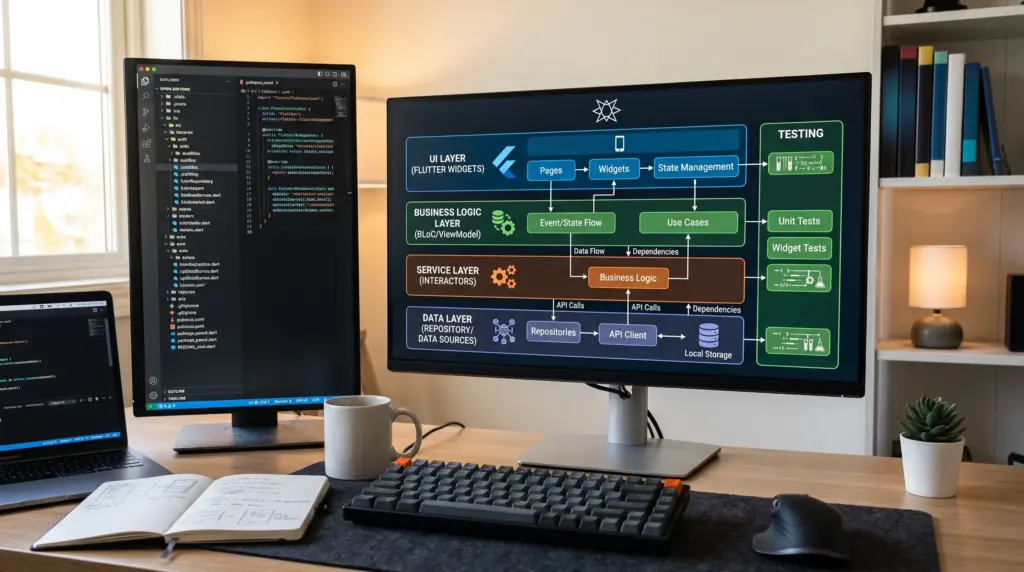
A good architecture improves testing and future development. Furthermore, Flutter documentation emphasizes organized architecture. It is an important foundation for building scalable apps.
Core Architecture Elements:
- Separate Components: First, keep the interface and data layers organized. Consequently, each part can be updated without affecting other components.
- Manage App State: Additionally, select a state management approach that matches the app’s size. Therefore, you avoid unnecessary technical overhead.
- Reuse Code: Finally, build reusable components instead of repeating code. Thus, you reduce errors and simplify future development.
Improve Flutter App Performance
App performance depends on how you handle interfaces and data. Therefore, you should monitor performance throughout development instead of fixing issues after launch.
Effective Performance Practices:
- Reduce Rebuilds: First, identify components that rebuild too often. Consequently, you can organize state efficiently to minimize repeated rendering.
- Optimize Images: Additionally, use suitable image formats. Moreover, reduce oversized files to prevent high memory consumption.
- Test Performance: Finally, test the app across different devices. Thus, you can monitor response times and behavior under heavy loads.
Select Suitable Hosting for the App
Online apps need reliable hosting for requests and data. Therefore, your choice must depend on performance and traffic rather than price alone.
Important Hosting Criteria:
- Available Resources: First, compare CPU and memory with your requirements. Consequently, you prevent resource limits from hurting performance.
- Scalability: Additionally, choose flexible infrastructure. Thus, resources can increase as demand grows without a complete redesign.
- Reliability: Finally, review backup systems and service availability. Therefore, you ensure a stable hosting environment.

Build a Scalable Cloud Infrastructure
A flexible cloud infrastructure responds to changing demand. Furthermore, scalability is crucial when traffic increases unexpectedly. According to CNCF’s 2026 annual survey, 82% of container users run Kubernetes in production.
Foundations of Flexible Infrastructure:
- Automatic Scaling: First, use tools that increase resources during high demand. Consequently, you maintain a balance between cost and performance.
- Load Distribution: Additionally, distribute requests across resources. Thus, you reduce pressure and improve stability during traffic spikes.
- Service Separation: Finally, separate important components. Therefore, you can update specific services without affecting the whole system.
Connect Flutter with Backend Services Efficiently
Flutter apps rely on backend services to exchange data. Therefore, API design and network management significantly affect speed and user experience.
Ways to Improve Backend Communication:
- Use Organized APIs: First, design clear endpoints and responses. Consequently, you request only required data and reduce network usage.
- Handle Errors: Additionally, account for connection failures and timeouts. Therefore, you show clear messages instead of blank screens.
- Reduce Requests: Finally, cache reusable data. Thus, you minimize unnecessary communication between the app and backend.

Protect Data During Storage and Transfer
App security covers data moving between devices and servers. Furthermore, you must consider security during architecture planning rather than later.
Essential Data Protection Practices:
- Encrypt Connections: First, use secure connections for data transfer. Consequently, you protect sensitive account details.
- Protect Credentials: Additionally, avoid placing secrets in code. Therefore, you use secure mechanisms to manage credentials.
- Limit Permissions: Finally, give each service only required permissions. Thus, you reduce damage if an account is compromised.
Manage Databases and Data Storage
Database selection reflects information type and expected workload. Proper storage design helps maintain query performance. According to Stack Overflow’s 2025 Developer Survey, over 49,000 people from 177 countries participated.
Practical Data Management Tips:
- Choose the Right Type: First, select a database based on data structure. Consequently, it matches your application requirements.
- Optimize Queries: Additionally, monitor slow queries and use indexes. Therefore, you reduce retrieval time for frequent data.
- Maintain Backups: Finally, establish regular backup procedures. Thus, you ensure information can always be recovered.

Monitor the App and Cloud Infrastructure
Development does not end after deployment. Performance and resource consumption change as usage increases. Therefore, continuous monitoring helps identify issues early.
Key Metrics to Monitor:
- Response Time: First, track how long important requests take. Consequently, you can investigate performance bottlenecks.
- Error Rates: Additionally, monitor application and backend errors. Therefore, you identify recurring problems and prioritize fixes.
- Resource Usage: Finally, track CPU and memory consumption. Thus, you spot resource pressure before limits are reached.
Test Before and After App Launch
Testing helps identify issues before they affect users. Furthermore, testing must continue after launch during updates. Stack Overflow’s 2025 Developer Survey found that 69% of respondents learned a new technique last year.
Essential Testing Stages:
- Functional Testing: First, verify core features and user scenarios. Consequently, you catch unexpected conditions early.
- Device Testing: Additionally, test across different screen sizes. Therefore, you maintain a consistent user experience.
- Load Testing: Finally, test backend services under high traffic. Thus, you identify capacity limits and extra resource needs.